
Senast uppdaterad: 2011-05-16

Itinerary

Day 1, Granada

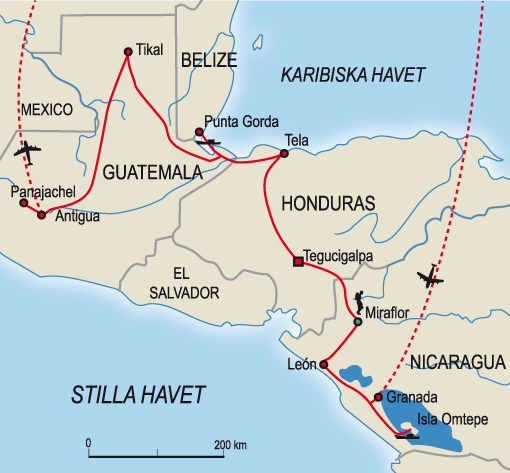
The tour starts in Granada, Nicaragua. This is a beautiful colonial city not far away from the capital Managua's airport and much nicer then the capital city itself.

Day 2-3, Isla Ometepe

You leave Granada in the morning and travel by bus to Rivas from where you catch the ferry that will take you into the large lake Lago Nicaragua and the volcanic island called Isla Ometepe. Its name derives from the Nahuatl words ome (two) and tepetl (mountain), meaning two mountains. It is the largest island located in the Lake Nicaragua as well as the largest volcanic island inside a fresh water lake in the world. The two volcanoes, Concepción and Maderas, are joined by a low isthmus to form one island in the shape of an hourglass. Ometepe is 31 km long and 5 to 10 km wide. The island has a population of 42,000, and an economy based on livestock, tourism and agriculture. Bananas and tobacco are some of major crops. There are lots of interesting things to do on the island. One activity is to walk up the slopes of the volcanoes, passing a waterfall and ancient petroglyphs left by the island's original inhabitants. You can also go on an excursion to observe the wildlife. Ometepe harbors large populations of the White-faced Capuchin monkey and populations of the Mantled Howler monkey. Or why not rent a bike or swim in the warm lake?

Day 4-5, León

You leave Isla Ometepe in the morning and travel by ferry and bus to León, Nicaragua's second largest city. León was one of Nicaragua's most important cities during the colonial times and became the independent republic's first capital. The city center is full of historic houses and churches which rivals the ones in Granada. But León also has a fascinating modern history. The city was a center for the Sandinista rebellion during the civil war. Paintings on the walls tell about this part of Nicaragua's history and don't miss the museum of the revolution where the main attractions are the guides who not so long ago fought on the streets of León

Day 6-7, Miraflor

You continue by bus to the north to Estelí from where you continue up in a mountainous area called Miraflor. This is a beautiful green part of Nicaragua with rolling hills. The local farmers who are organized in cooperatives have started to receive guests. You can choose to stay with a local family or in a small cottage. The area has a mixed landscape of tropical forest and agricultural lands. There are good opportunities for hiking and horseback riding. It is also possible to visit one of the small coffee farms to learn more about the production. And it is very interesting to listen to the locals' stories. This part of Nicaragua suffered badly during the Contras-war.

Day 8

Back to Estelí and by bus for around three hours towards the border. After crossing the border and entering Honduras you continue for a couple of hours until you reach the capital city Tegucigalpa. You rest and spend the night in the center of the city.

Day 9-11, Garifuna Coast

You leave early and travel approximately eight hours until you reach Tela on the Caribbean coast. The main reason for visiting this area is not only Tela itself but the excellent and very interesting excursions to the surrounding area. Standing on the beach in Tela and looking to the east, you can see Punta Izopo with Refugio de Vida Silvestre Punta Izopo. The Ríos Plátano and Xicaque are flowing through the wildlife refuge and spread into a network of canals passing through mangrove forests. These are home to abundant wildlife including monkeys, crocodiles, turtles, parrots, toucans and many other bird species. Gliding silently through the mangrove canals in a kayak, you can get close to the wildlife without disturbing it. And bring your swim suite since it's a "wet" experience. Standing on the beach at Tela and looking to the west, you see a long arc of land curving out into the ocean some 20 kilometres away. This is Parque Nacional Marino Punta Sal, a lovely place with palm-fringed beaches and blue lagoons. Within the national marine park are various habitats, including mangrove forests and swamps, a small tropical forest with howler monkeys roaring in the canopy, offshore reefs and several coves. You can see many species of birds, especially from November to February when migratory species are here. Completely unspoiled, this park will make a fine all-day outing from Tela. Another option is to visit the Garifuna villages that are within reach of Tela. All of them are right on the coast, with splendid beaches, simple houses shaded by coconut trees, fishing canoes resting on the sand and tiny restaurants serving delicious Garifuna food. Specialities are seafood soups and fish cooked in coconut. Adding to the attraction are the peaceful and friendly Garifuna people. The Garífuna are ethnically descended from Indigenous and African people; their Garifuna language is a member of the Arawakan language family. The possibility of attending a Garifuna dance will be given only at weekends. The traditional Garifuna band is composed of three large drums, a turtle shell, some macas and a big conch shell, producing throbbing, haunting rhythms and melodies. The dance is the punta, a Garifuna dance with a lot of hip movement. Often the dancers are in costume, with the women in long, loose, colourful skirts.

Day 12-13, Punta Gorda

You will go by bus from Tela into Puerto Barrios at Guatemala's northern coast facing the Caribbean Sea and then by boat (1 hour) to Punta Gorda in Belize. Note! This can be a rough trip if its bad weather so come prepared. Bring sunglasses to protect your eyes and a raincoat (or even better - a light, cheap poncho) if necessary (you will not have access to your luggage during the journey). Punta Gorda, or simply "PG" as it is known throughout Belize, is a marketing centre and fishing port with a varied ethnic makeup: Creoles, Kekchi, Mopan, Chinese, East Indians, etc. PG was founded in 1832 by the Garifunas who where expelled from Saint Vincent Island by the British. Here you will have free time to enjoy the relaxed Belizian way of life. With street names like Front, Main and Back street it isn't difficult to find your way around. It is also possible to arrange snorkling excursions to the rich waters off the coast.

Day 14-15, Village Stay

You will take a local school bus to one of the small Maya villages in the countryside. The bus serves as an important link between PG and the scattered villages in the surrounding mountains. It is used for diverse uses as commuting children to school and heavy cargo transportation. You will stay with local families, who will welcome you into their home, provide you with a hammock (or bed) and meals and also let you share their traditional way of life. No special allowances are made for you, in return for roughing it, you will learn a lot about Mayan way of life. Most villagers carry on traditional lifestyle: women wash their clothes in a nearby river and cook over fire in the corner of the house; men tend to livestock and the family plots of corn. Visitors are similarly treated according to gender. There are usually no flush toilets, no electricity (there are some exceptions) and no running water. Many express fears for what the arrival of power (and television) will do to their culture, and are keen to protect their heritage. You will have plenty of time talking to the people in the village and participate in ordinary village activities. If you wish and there is opportunity the Mayan families can show you how to properly prepare a good tortilla, the complete process. From harvesting the maize (in season) and grinding it, to actually cooking it and turning it into a delicious tortilla. During the stay you will also have time to ecplore the surroundings. One recommended excursion, if the chosen village happens to be nearby, is to visit the farm Dem Dats Doin, an innovative ecological farm managed by Alfredo and Yvonne Villoria. They have photovoltaic cells for electricity, biogas methane for light and refrigeration, natural insect repellents and fertilisers in place of chemicals. Dem Dats Doin is a showcase of what determined, sensitive and knowledgeable people like the Villorias can do to promote appropriate technology and sustainable farming. It can become cold at night in Belize, despite temperatures of 25-30 degrees during the day. For those of you that have a tendency to feel frozen and believe you need it - bring a sleeping bag. Or bring an old blanket that you can leave to the village as a gift.

Day 16-17, Tikal

The boat from Punta Gorda will take you back to Guatemala, where you continue by bus north towards Flores and Tikal. This relatively small town situated on an island in the Lake Petén Itzá offers a sense of calm and tranquillity not seen in other towns of this frontier zone. Flores dates back years, to 1221, when an Itzá Mayan ruler from the Yucatán stole the bride of one of the lords of the neighbouring city of Izamal. Hunac Ceel, the offended neighbour, invaded the area and drove the Itzá southward. They finally settled on the shores of the lake and built the city of Tayasal (Flores) on the island. After the conquest, the Maya leader Kanek organised in Flores the resistance against the Spaniard's troops. The main reason for coming to Flores is to visit Tikal, possibly the most magnificent of all Maya sites. This was once a very important Maya city and home to imperious Mayan rulers dripping with jade. The total urban area was more than 11 sq. Km, with the population somewhere between 50 000 and 100 000. The low site of Tikal was first occupied around 600 BC during the Precalssic era. Its buildings dates from 300 BC but it became an important Maya centre from AD 300 onwards. The area is dominated by five enormous temples: steep-sided limestone pyramids that rise to more than 60m above the forest floor. Around them are literally thousands of other structures, many semi-strangled by giant roots and still hidden beneath earth and platnts. You can walk around here for hours exploring the amazing site. The setting of the ruins in the middle of the jungle makes the experience even more impressive. Tikal is surrounded by the Parque Nacional Tikal, a protected area of some 576 square kilometers, and the trees around the ruins are home to hundreds of species, including howler and spider monkeys, toucans and parakeets. On the last evening you take a night bus to Guatemala City and on to Panajachel.

Day 18-20, Lago Atitlán & Guatemalan Highland

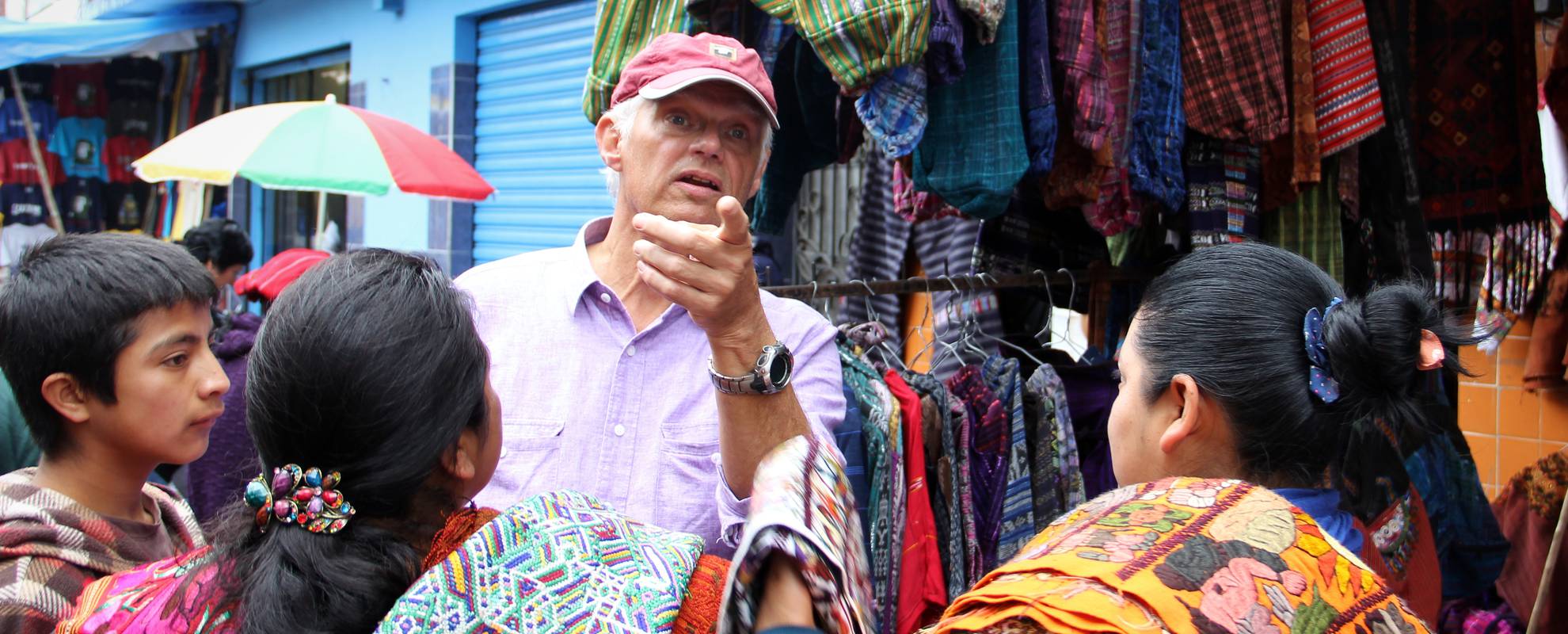
Panajachel sits on the shores of the beautiful lake Lago Atitlán. Panajachels surrounding is what makes this such an enjoyable area. You can use Panajachel as your base to explore nearby attractions. They include the spectacular surrounding scenery, with smoking volcanoes around deep blue colours of Lago Atitlán. You can also explore the countryside by taking a local bus north of the town Sololá towards Los Encuentros and step off the bus somewhere along the road. Then head back by foot towards Panajachel. You will pass small villages and see how ordinary highland Guatemalans live in the country side. You will most likely be greeted with smiles from local children along the road. Sololá itself is a charming village, where many tourists change buses but few stop by to explore the surrounding beyond the bus station. Those who do will find a friendly relaxing place with many local indigenous groups and a colourful market. Take the opportunity to go by local bus to the town of Chichicastenango, known as simply "Chichi". At an altitude of 2,017 m, this highland town is one of the most important and colourful market towns in Guatemala. Surrounded by valleys, with nearby mountains looming overhead, Chichicastenango seems isolated from the rest of Guatemala. With its narrow cobbled streets and red-tiled roofs enveloped in mists, as they often are, it can seem magical. Chichi is a beautiful, interesting place. Villagers from throughout the region would walk for many hours carrying their ware to participate in the commerce here. When they reach Chichi´s main square on the night before the market, they lay down their loads, spread out a blanket and go to sleep in one of the arcades that surround the square. At dawn on Thursday and Sunday they spread out their vegetables, fruits, chunks of chalk (ground to powder, mixed with water and used to soften dried maize), balls of wax, handmade harnesses and other wares and wait for customers. Another option is to visit the much less tourist-influenced market at San Francisco El Alto, where Friday is market day. There are many other good excursions in the surrounding area. One of the days can be devoted to a boat tour on Lago Atitlán, and visits to the picturesque villages of San Pedro La Laguna, Santiago Atitlán and San Antonio Palopó. If you want to visit a pleasant, pretty Guatemalan highland town San Miguel Totonicapán (2,500 meters) is a good place to go. The Casa de la Cultura Totonicapense has displays of indigenous cultures and crafts. Another alternative and well-recommended excursion is to Zunil (altitude: 2,076 m). This is a pretty agricultural and market town in a lush valley framed by steep hills and dominated by a towering volcano. Half a block downhill from the church plaza the Cooperativa Santa Ana is a handicrafts cooperative in which over 500 local women participate. Handicrafts are displayed and sold here. Nearby is Fuentes Georginas. Imagine a steep, high wall of tropical verdure - huge green leaves, ganglions of vines, giant ferns, spongy moss and profusion of tropical flowers at the upper end of a lush mountain valley. At the base of this wall of greenery is a limpid pool of naturally warm mineral water. This is the prettiest spa in Guatemala. Though the setting is intensely tropical, the mountain air currents keep it deliciously cool all day. The last day you will leave Panajachel and travel back to Antigua Guatemala.

Day 21-22, Antigua

You have two days in Antigua Guatemala, Guatemala's previous capital. Antigua is among the oldest cities in the Americas and considered by many as the most beautiful. Its setting is between three magnificent volcanoes: Agua (Water), Fuego (Fire) and Acatenango. Fuego is easily recognisable by its plume of smoke and - at night - by the red glow it projects against the sky. It has minor eruptions on a regular basis, causing a downpour of ash on Antigua and surrounding villages. You will have time to explore the colonial city. Take advantage of this rare opportunity to stroll around the old cobbled streets and observe the beautiful colonial buildings set amid towering volcanoes. A good recommendation is to visit the local market.

Day 23

The tour ends in Antigua. From here it is not far to the airport of Guatemala City.