Senast uppdaterad: 2012-04-17
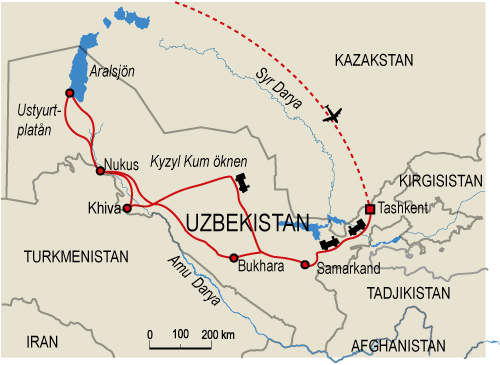
Itinerary
Day 1
You will meet up with the group at the hotel in Tashkent.
The Uzbek capital was destroyed in an earthquake in 1966. Today it consists of broad avenues framed by post-soviet follies. In the middle of this you will find oases, like Chorsu Bazaar. Maybe you would also want to visit Khast-Imam Square, which could be defined as the modern religious centre of Uzbekistan. By the square you will find Moyie Mabarek Library Museum. The library boasts a Quran from the 7:th century, considered to be the oldest one in the world.
Close to the Khast-Imam Square the old town begins. A neighborhood like this is called a malhalla. You will enjoy walking in the narrow, winding lanes. The houses are built of baked mud and are blank on the outside, not revealing anything about its inhabitants. If you are lucky, you will get a glimpse of the calm inner courtyards, shadowed by vine and fruit trees.
Day 2-4
Train to Bukhara.
You will spend two full days in the city that is called "The Dome of Islam" and "The Beauty of the Spirit". Very little has changed in the city center during the past millennia and therefore it is a good place to get a glimpse of pre-Russian Turkestan. Most of the sights are concentrated in the old part of the city - the shakhristan - as well as your hotel. Your tour leader will take you on a guided walk in the old part of Bukhara.
The Ismael Samani Mausoleum is one of the architectural highlights in Uzbekistan and it is sacred to the locals. The almost perfect brick cube was built in the beginning of the tenth century. It has a combination of elements from different architecture styles, among them shapes found in sacred Zoroastrian temples.
The Ark Fortress is the former royal town-within-the town. In front of the fortress is the Registan; medieval Bukhara's main square.
The religious heart of Bukhara is the square framed by the Kalon Minaret, the Mir-i-Arab Madrassah and the Kalon Juma Mosque. The Kalon Minaret is the symbol of Bukhara, towering over the city at 48 meters. The minaret has dominated the city's skyline for more than eight and a half centuries. The Kalon Juma Mosque was built to house the entire male population of Bukhara - big enough for ten thousand people - and is one of the most ancient mosques in Central Asia. The Mir-i-Arab Madrassah is still a blooming Islamic school. It has ranked as the most prestigious educational establishment in Central Asia for centuries. Especially in sunset, it is also one of Uzbekistan's most striking buildings.
The pool and the chaikhanas (open air tea houses) of the Lyabi-Hauz Plaza is the very center of old Bukhara. Even though it is crowded with tourists and the city's government has placed a lighted duck-house in the pool (!) the plaza is an interesting place and has an air of the old times. Mind that it is in Bukhara that you should try shashlik (grilled meat on a stick) and a good place to do it is in one of the restaurants at the Lyabi-Hauz Plaza.
You will also enjoy walking in the covered Bazaars. The skilful architecture of the bazaars makes the air circulate even during the hottest days. Today the bazaars are given over to tourist shops. Try to find your way to the nice spice dealer, where you can buy spices of all kinds at good price.
Day 5-6
By bus to Khiva through the Kyzyl Kum Desert (the red desert). The journey will take approximately ten hours.
Khiva is situated in Khorezm, an ancient land including parts of today's Turkmenistan. Khiva is the most intact of Central Asia's Silk Road cities. Since it is also very remote, it was long a hideout for slave-traders, thieves and pirates. When the sun sets and the stars light up on the sky, the old city transforms into a gigantic sandcastle and looking to the horizon it is easy to imagine camel caravans slowly swaying through the desert to the city.
You will stay in the old town. Your hotel is situated in the former Mohammed Amin Khan Madrassah. The old Islamic school once had a capacity of 250 students. Today the study cells, called hurjas, have been transformed into comfortable hotel rooms. Only a few steps from the Medrassah stands the Kalta Minor Minaret; the number one photo object in Khiva. The minaret is intricately ornamented in a typically Khivan shade of jade. If you climb the sixty four steps to the top of the tower, you get a good view of the city.
Your tour leader will take you on a guided walk in the old part of Khiva.
Day 7
By bus to Nukus, via the ancient Zoroastrian ruins Ayaz-Kala and Toprak-Kala. Zoroastrianism is a religion that preceded Judaism, Christianity and Islam. This old system of belief was practiced by the people once inhabiting ancient Khorezm.
The land between Khiva and Nukus is formed and fed by the Amu Darya Delta. Here the river provided a cradle for Central Asia's earliest civilization. Over the centuries, the Amu Darya River has changed course several times, killing cities at a whim and giving birth to new ones.
You will arrive to Nukus in the early afternoon. Nukus is the capital of Karakalpakstan, which is an ill-defined "autonomous" republic in Uzbekistan. "Karakalpak" means black hat and the republic's people are former nomads, with language and traditions closely linked to the Kazakhs.
The main attraction in Nukus is the Igor Savitsky Museum, home to one of the finest collections of Soviet avant-garde art from the 1920s and the 30s. When Stalinist socialist realism became the only acceptable form of Soviet art, Nukus' backwater obscurity enabled Savistky to collect a wide spread of art. Today the museum holds some 90 000 pieces of art, including more than 15 000 paintings (even though only a fraction are actually displayed).
Day 8-9
At dawn, you will start the journey to the Aral Sea. You will travel by jeep, on bumpy roads through the dry Karakalpak semi-desert, until you reach the Ustyurt Plateau. Here the road ends and the rest of the way you will travel through a seemingly endless, stony desert.
The Aral Sea has been dried and doomed to die because the Soviet planners decided to make Kazakhstan, Uzbekistan and Turkmenistan a center of cotton production. The two great rivers that used to provide the Aral Sea with fresh water from the eastern mountains, Syr Darya from the Kazak side and Amu Darya from the Uzbek side, were rapidly drained through an endless number of dams and irrigation canals. The consequence was that the Aral Sea ceased getting influx of fresh water. Today, Syr Darya only connects to some smaller lakes in Kazakhstan and Amu Darya does not connect to any lake at all. The really sad thing in the story is that cotton is no ideal crop in Uzbekistan, nor in Kazakhstan or Turkmenistan.
Why would anyone want to go into the desert to seek out a lost sea? The answer might be that you want to see for yourself how humankind has put Mother Nature out of balance. The Aral Sea covered an area of 66 000 square kilometers in the beginning of the 1960s; 2010 the same figure was 12 000 square kilometers. At the same time the salt content has risen from 11 grams per liter water to 110 grams. Today, nothing can live in the water that once was the living base of tens of thousands of people. In less than one generation, life has changed entirely and the possibility to live by the sea and get an income from it has disappeared. In the same area where there once was a huge, healthy and rich sea, you now travel through a salty, poisonous desert.
Late in the afternoon you will arrive to what remains of the Aral Sea. You will probably want to go for a swim. "Swimming" in the Aral Sea is an unusual experience; due to the water's saltiness you will float like a cork. After preparing your night camp, you will have dinner cooked over open fire. After a night spent in a tent, you should not miss the early hour when the sun rises over the sea; it is an almost magical experience to see the sun slowly color the sky red and finally climb over the horizon.
If possible, you will return to Nukus via the former fishing town Moynaq (the ground conditions decide if it is possible to drive via Moynaq or not). Moynaq, once a blooming center for Uzbek fishing industry, is today a dusty ghost town, inhabited by a rubble of its former population. A big part of the people who still lives in Moynaq works in the gas and oil industry that has come in the traces of the draining of the sea. In Moynaq you also find the famous spot of beached ships; an armada of rusting fishing ships, forever stranded.
Day 10-13
Train to Samarkand, a journey which takes approximately 15 hours. You will arrive in the middle of the night and go to your centrally located hotel.
Samarkand is one of the oldest settlements in Central Asia. It has always been cosmopolitan, since it is a key Silk Road city, on the crossroads leading to China, India and Persia. When Alexander the Great conquered the city, he said "Everything I have heard about Samarkand is true, except that it is more beautiful than I ever imagined!". In the 14th century Timur the Conqueror decided to make Samarkand his capital. He forged an almost mythical city, Central Asia's economic and cultural epicenter. After Timur, the grandson and scientist Ulugbek ruled and made Samarkand into an intellectual centre as well. Your tour leader will take you on a guided tour in this truly magnificent and romantic city.
In the very middle of the city is the Registan, an ensemble of three majestic medrassas, overloaded with majolica and azure mosaics. The edifices are among the world's oldest preserved medrassas. The Ulugbek's Medrassa, situated on the west side, is the original one. It is said that the great scientist Ulugbek tought mathematics, theology, astronomy and philosophy here. On the east side is the Sher Dor Medrassa (the "Lion" Medrassa) and on the north side is the Tilla-Kari Medrassa (the "Gold-Covered" Medrassa).
Also in the center of the city, you will find the enormous Bibi-Khanym Mosque. Legend says that Bibi Khanym, Timur the Conqueror's Chinese wife, ordered the mosque build as a surprise while her husband was away. The architect fell madly in love with her and refused to finish the job unless he could give her a kiss. The smooch left a mark and Timur, on seeing it, executed the architect and decreed that women should henceforth wear veils so as not to tempt other men.
Timur the Conqueror, two sons and two grandsons, including Ulugbek, lies in the Gur-e-Amir Mausoleum. As with other Muslim mausoleums, the stones are just markers; the actual crypts are in a chamber beneath. There is an anecdote saying, that when the Soviet anthropologist Mikhail Gerasimov opened the crypts in 1941, he found on Timur's grave an inscription to the effect that "Whoever opens this will be defeated by an enemy more fearsome than I". The next day, 22 June 1941, Hitler attacked the Soviet Union.
In the northern part of the city, you will find the remains of Ulugbek's Observatory. Ulugbek was probably more famous as an astronomer than as a ruler. His astrolabe, designed to observe star positions, was built in the 15th century. The small museum next to what remains of the observatory is also well worth a visit.
Samarkand also has a modern, Russian part. A stroll through these pulsating, living quarters is highly recommendable and will provide you a richer picture of the city. Samarkand of today is still cosmopolite and colorful with its broad mix of ethnicity.
One of the days in Samarkand you will make an excursion to the Zerafshan Mountains, south-east of the city. In the small village Sufia, there is a well considered to be sacred by the locals. Maybe it is not so strange that water is holy, in a country where clean water is worth its weight in gold. Also, "Zerafshan", means "golden gift". You will also visit the small village Urgut and its colorful market. Take the opportunity to try samsa, a kind of pirogue baked on the walls in a töndir (a big, circular clay oven). In the afternoon you will spend time with a local family and you will also be invited to have lunch in their home.
Day 14-15
Train back to Tashkent, where you will have a few hours free for your own activities and shopping before you go home.